




Hand-Eye Coordination Project
The hand-eye coordination project is designed to measure the hand-eye coordination of the patients in the pediatric rehabilitation center. The device measures how fast a patient can react and how many times they are correct in their reactions. The physical therapists at St. Vincent’s Hospital will use this data to test the effectiveness of the physical therapy and to see the progress of each pediatric patient. This project is in its third semester.
Games designed in the past utilized a Rock Band Drum in conjunction with a flash game. The games developed were the Fly Swat game which consists of the patient hitting the corresponding drum pad to the one the fly lands on. The reaction time is calculated by the time it takes the patient to hit the pad after the fly lands. The patients were anticipating where the fly would land, which resulted in them hitting the drum too early and receiving an error.
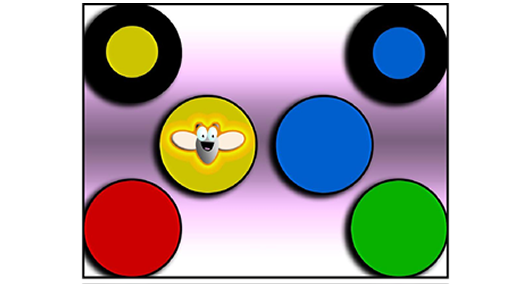
The Reaction Game game is similar to the Fly Swat Game, but the fly is replaced by a box with falshing colors. The users have to hit the corresponding drum pad as the color flashes in the color box. The reaction time is mearsured from the time color appears in the box till the time the patient hits the drum pad. An application, JoyToKey, is used to convert the input signals of the drum set to a signal usable by flash.
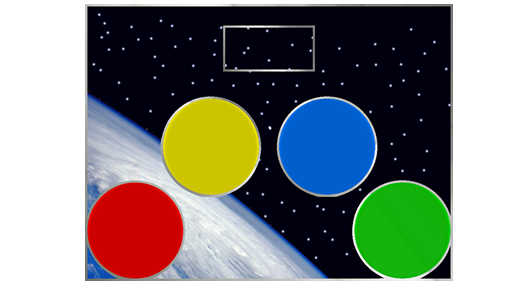
End of Semester Update: After gaining feedback from the midsemester design review, we prioritized our tasks in the following manner: improving the Simon's game, brainstorming new games in the seven new areas of visual-perceptual skills, and creating the new game as decided by the team based on different ideas and designs.
The seven areas of visual-perceptual skills that the therapists have introduced to us have been researched. Our team has also outlined possible games or activities that could be associated with each one.
The game that we developed at the end of semester Fall 2012 is named as The Oultine game. It is based on the visual closure category of the 7 areas of visual-perceptual skills. Visual Closure is the ability to complete the partial information/pictures/ words given.In this game, the child is shown outline of a picture and 4 options are given. The child has to choose the option that best describes the picture. The scoring sysytem works fine and is based on how correct the selected option is and the time taken to select an option.

For The Simon's Game future team needs to develop a new criteria of calculating the percentage of correct hits. Remembering the long pattern is a current issue in Simon's Game. So the minimum length of the pattern is to be reduced such that children are able to play it.
HEC Hardware Team
For Fall 2012, the Hardware team has been focusing on improving the durability and accuracy of the drum pad. We began by brainstorming and decided on an idea that resembles a piano key or a lever. When force is exerted on one end, the other end will raise, closing the circuit and thus, creating a hit. A weight will be placed on the same end as the circuit so gravity will reset the lever. We chose this idea in hopes to increase the durability and the accuracy of system. Our design is mechanically based and has cushions to prevent harsh smacking between the parts. We built a prototype made of Styrofoam and cardboard to test our idea. (Pictures are on the final semester design review PowerPoint). The prototype has the actual dimensions of the Rockband Drum Set so this confirmed that our design will work with the drum pad. We began researching and figuring out the best circuit to use to power the Arduino, which will collect the data and transmit the hits to the computer.
Our goals for the future of the project are to continue with this idea. A list of materials needs to be made and the materials need to be ordered. Then, an actual prototype should be build and tested to see if it works in both the inner and outer drum pads of the Rockband Drum Set (the dimensions for the inner two drum pads are slightly different than those of the outer two). A way to test the durability and accuracy of the design is to set it up in the EPICS Lab and ask anyone passing by to please hit the drum pad. When they do this, they should record the number of hits and intensity that they hit the drum pad with (hard, soft, ect). Before testing however, the circuit needs to be completed so when testing begins, there will be something to collect the data and tell if the design is accurate in recording the hits.
Current Projects
Past Projects
- AAC
- BALL
- BIKE
- Braille eReader
- AMC
- Fatigue
- FMT
- Hand
- HEC
- Hippotherapy
- ICD
- Leg1
- Leg2
- Medicine Cabinet
- Microcontrollers
- Iron Man
- Riley
- SOM
- VENT